| Scenic Mobile Station v2 | |
|---|---|
 |
 |
| Stage Side | Service Side |
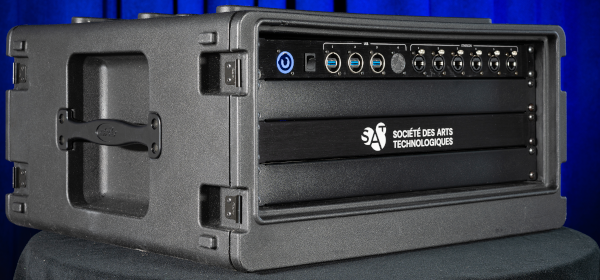
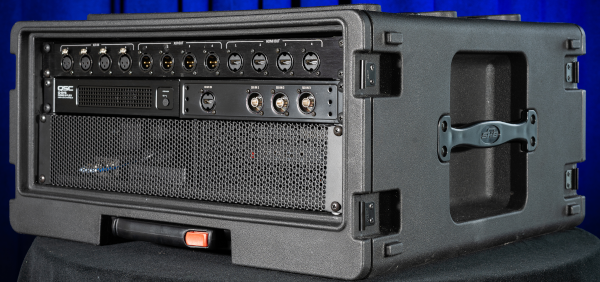
The Scenic station connects professional stage equipment to other venues equipped with the same station via the Internet. Developed as open-source software, the Scenic application, which manages the heart of the station, is ideal for developing new forms of creation and distribution by integrating telepresence and remote control of audiovisual and IT equipment. In short, the Scenic station enables both stage telepresence and web event streaming by offering:
-
Ultra-low latency audio and video compression/decompression;
-
Centralized management of multiple audio, video, and data streams in and out;
-
Easy connection to professional equipment;
-
Transmission of audio and video streams over the local network using the NDI® standard.
Physical and hardware specifications
Dimensions and weight
| Length | Width | Height | Weight |
| 67.31 cm | 57.15 cm | 29.21 cm | ≈43 lbs |
Transport conditions
Built-in equipment
| Computer | Lenovo Thinkstation P3 Ultra |
| Graphics Card | 4GB NVIDIA Quadro P1000 Pro Series 5K PCIe low profile |
| Video Capture Card | Magewell Eco Capture M.2 Quad SDI |
| Router | MikroTik hAP ax3 |
| Network Switch | TP-Link TL-SG108PE 55W POE |
| Audio Console | QSC CORE-8FLEX |
| Video Converter | Blackmagic Design MicroConverter BiDirectional SDI/HDMI 3G |
| Ethernet Connectors | Neutrik Ethercon feedthrough NE8FDP-B 6x |
| USB Connectors | Neutrik USB feedthrough NAUSB-W-B 3x |
| HDMI Connectors | Neutrik HDMI feedthrough NAHDMI-W-B 7x |
| SDI Connectors | Neutrik SDI feedthrough NBB75DFIB 3x |
Connectors
Power
 |
 |
|---|
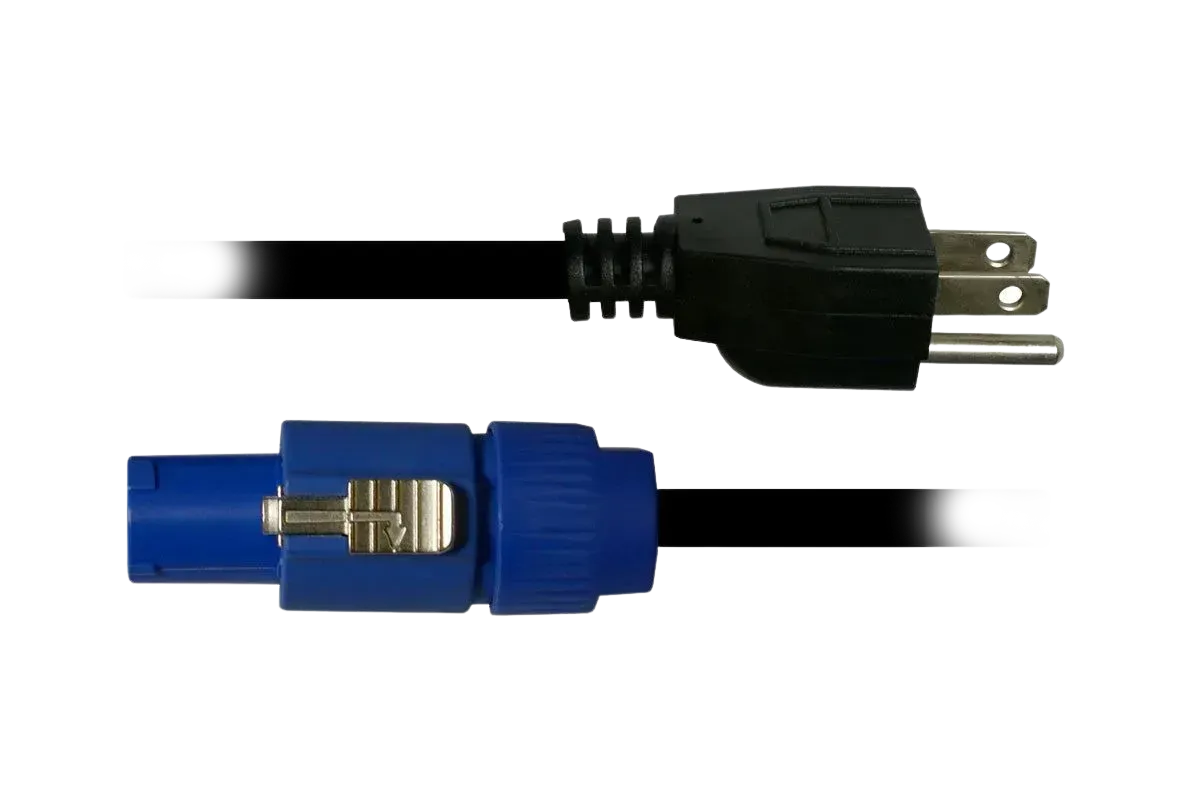
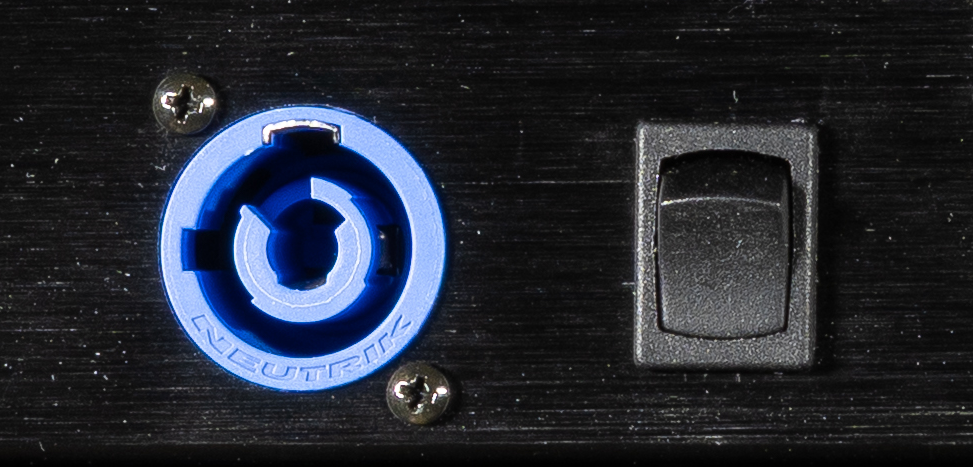
Power the Scenic Mobile station using the blue Type A PowerCon cable (see image above) and the power switch.
These stations are designed to operate on 110V/220V power. If all included systems are used simultaneously at full capacity, the station would draw around 1100W. However, since most situations only require partial use of the provided equipment, we estimate actual power consumption to be under 800W.
¶ Note
Before powering the station, please connect the desired video peripherals to the HDMI outputs, as the computer initializes these ports during boot. Otherwise, you will need to enable the outputs using the ARandR software, detailed here.
Video
Video Inputs
 |
|---|
The station has four video input connectors capable of capturing images over 3G-SDI (up to 1080p 60fps). The first input is an HDMI connector for universal compatibility, while the other three are standard BNC connectors for connecting to higher-end systems. In the Scenic matrix, these inputs correspond to video inputs HDMI, SDI 1, SDI 2, and SDI 3.
¶ Note
Many additional software video inputs can be created using the network NDI option.
Video Outputs
 |
|---|
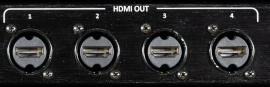
Four HDMI outputs are available, labeled HDMI OUT. They can be connected to projectors, monitors/screens, video switchers, or any other compatible system. Note that these four outputs are connected to the Nvidia graphics card, and the computer names them as DP-1, DP-3, DP-5, and DP-7 (based on their order on the patchbay).
Remember to connect all desired video peripherals before powering on your station; this will configure the outputs correctly. If you want to add video outputs after startup, you will need to enable them manually with ARandR, documented here.
In other words, if all four video outputs are connected at station startup, you should have the following list of available outputs in the Scenic software:
| HDMI output 1 | DP-1 | HDMI output 2 | DP-3 | |
| HDMI output 3 | DP-5 | HDMI output 4 | DP-7 |
Audio
 |
|---|
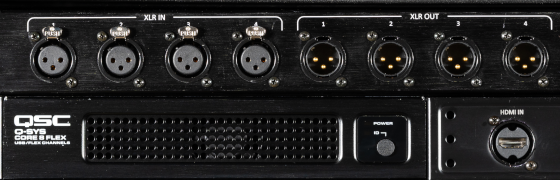
This version of the mobile station is equipped with a Q-SYS Core 8 FLEX interface from QSC, providing four XLR inputs and four XLR outputs, as illustrated above.
For more information on how this interface works, see the documentation here.
Network
 |
|---|
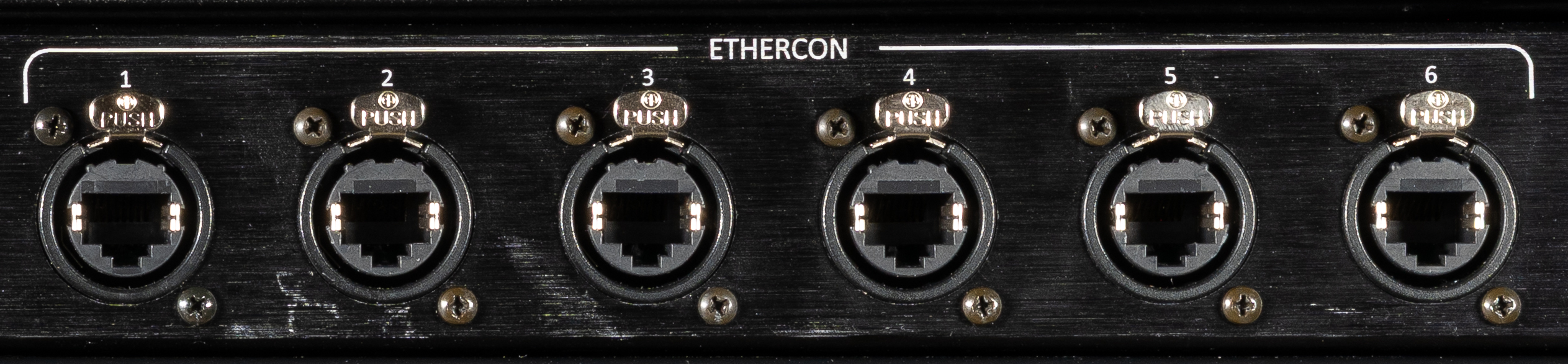
The station includes six Ethernet connectors as well as a wireless network to meet various networking needs. The table below shows the properties of each connector, and the section that follows provides a more detailed description of their capabilities.
| 1 | 2 | 3 | 4 | 5 | 6 |
|---|---|---|---|---|---|
| WAN 1 | WAN 2 | LAN 1 | LAN 2 | LAN 3 | LAN 4 |
WAN :: Wide Area Network
Connector 2 connects directly to the computer built into the Scenic case, allowing the computer to connect to a network other than the station’s network to send and receive data through that port.
¶ Note
The term WAN is sometimes used interchangeably with Internet because it represents the abstraction of the global network. In other words, if you want your station to be connected to the global network, you must plug your WAN connector into a local port that provides an Internet connection.
If you do not plug in the WAN port, you can still use the station for local projects as a media control room, and the internal router will still assign addresses to your equipment.
¶ Warning
If you connect to an Internet service provided by an institution, you may encounter limitations due to their firewall configuration, which is beyond our control. In that case, please contact your institution’s IT support team and explain your needs.
LAN :: Local Area Network
You can use one of these ports if you want to control the station via wired network from your computer, or if you want to connect a local device to Scenic that is compatible with the NDI service, or capable of sending/receiving local/remote OSC messages.
¶ Note
NDI-compatible systems connected this way will be visible in the Network/NDI section of the Scenic software matrix.
¶ Warning
Make sure the device you connect to a LAN PoE port can negotiate power. Otherwise, you may face issues. Some devices with Ethernet ports are not designed to handle incoming power and may suffer irreversible damage. If in doubt, consult the user manual of the device you want to connect.
WLAN [WiFi] :: Wireless Local Area Network
¶ Note
You can also send or receive NDI or OSC streams over this network.
¶ Note
The station’s internal router will assign your computer and other connected devices a private IP address in the 10.231.0.0/24 subnet.
USB
 |
|---|
¶ Note
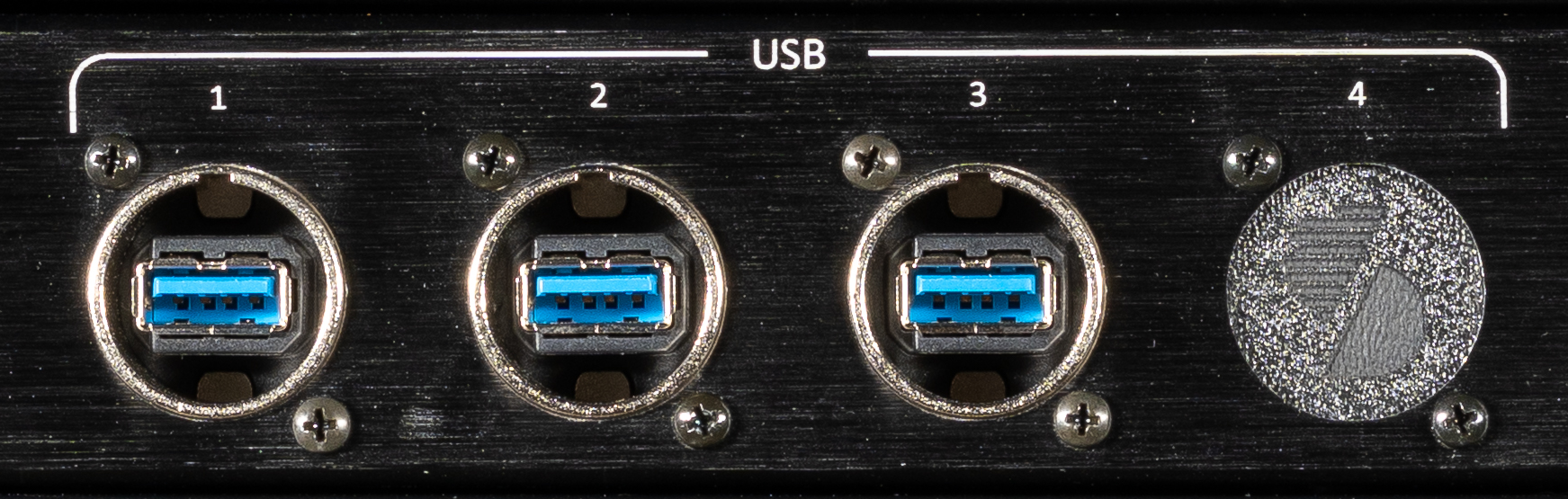
These connectors can be useful if you want to control the Scenic software suite directly from the station itself.
Computer system and software
Operating System (OS): Scenic OS based on the Ubuntu 22.04 Linux distribution
¶ Main installed software
- Scenic :: main tool for transmitting streams (audio, video, control, etc.) to a remote station over a wide area network;
- Q-SYS :: control interface for the QSC 8-COREFLEX, allowing automatic gain control (AGC :: Automatic Gain Control) and acoustic echo cancellation (AEC :: Acoustic Echo Cancellation)
- ARandR :: enables activating and deactivating video outputs
- OBS Studio is a free and open software for video recording and live streaming on the web. It can be used alongside the Scenic application via inter-application NDI audiovisual transmission. This application enables various image processing tasks, such as chroma keying, cropping video frames, trimming the broadcast frame, and other features tailored to streaming a telepresence event on a web platform.
Application icons
The taskbar at the bottom of the screen provides quick links to applications.
Some of the most important ones to know include the main menu, terminal access, ARandR video output management, and audio controls with Q-SYS. The Catia, Sonobus, and OBS applications also offer useful but optional utilities.

¶ Note
-
If you control the stations from their LAN/WLAN network, you will find the control panel and application icons at: http://10.231.0.10:3000/
-
If you control the station from its internal computer using a mouse, keyboard, and monitor connected directly to the station, you will find these icons on the main desktop displayed on your monitor.
| Applications menu |  |
Provides access to all applications installed on the Scenic station computer. |
| Scenic |  |
Starts Scenic. Desktop icon available only when the station is used as a control interface. Otherwise, in headless mode, use the following address: http://10.231.0.10:8080/?endpoint=10.231.0.10:8000 |
| Q-SYS |  |
For Mobile Station V2 Audio control interface for the QSC CORE 8FLEX |
| X-AIR-Edit |  |
For Pro / Mobile V1 Station Audio control interface for the Behringer XR18. |
| ARandR |  |
Interface visuelle simple pour les positions relatives des moniteurs. |
| OBS Studio |  |
An open-source screen capture and streaming tool for additional image handling. |
| Sonobus |  |
High-quality, low-latency peer-to-peer audio streaming between devices over the Internet or a local network. |
Control the station
This section explains how to connect to the Scenic application and its workspace depending on the method you choose.
To directly view how the Scenic application works, see the documentation here.
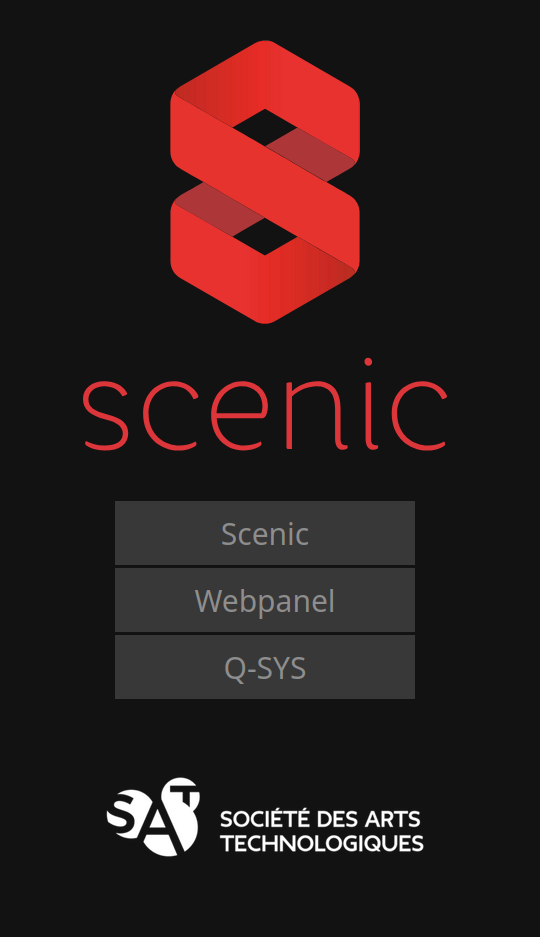 |
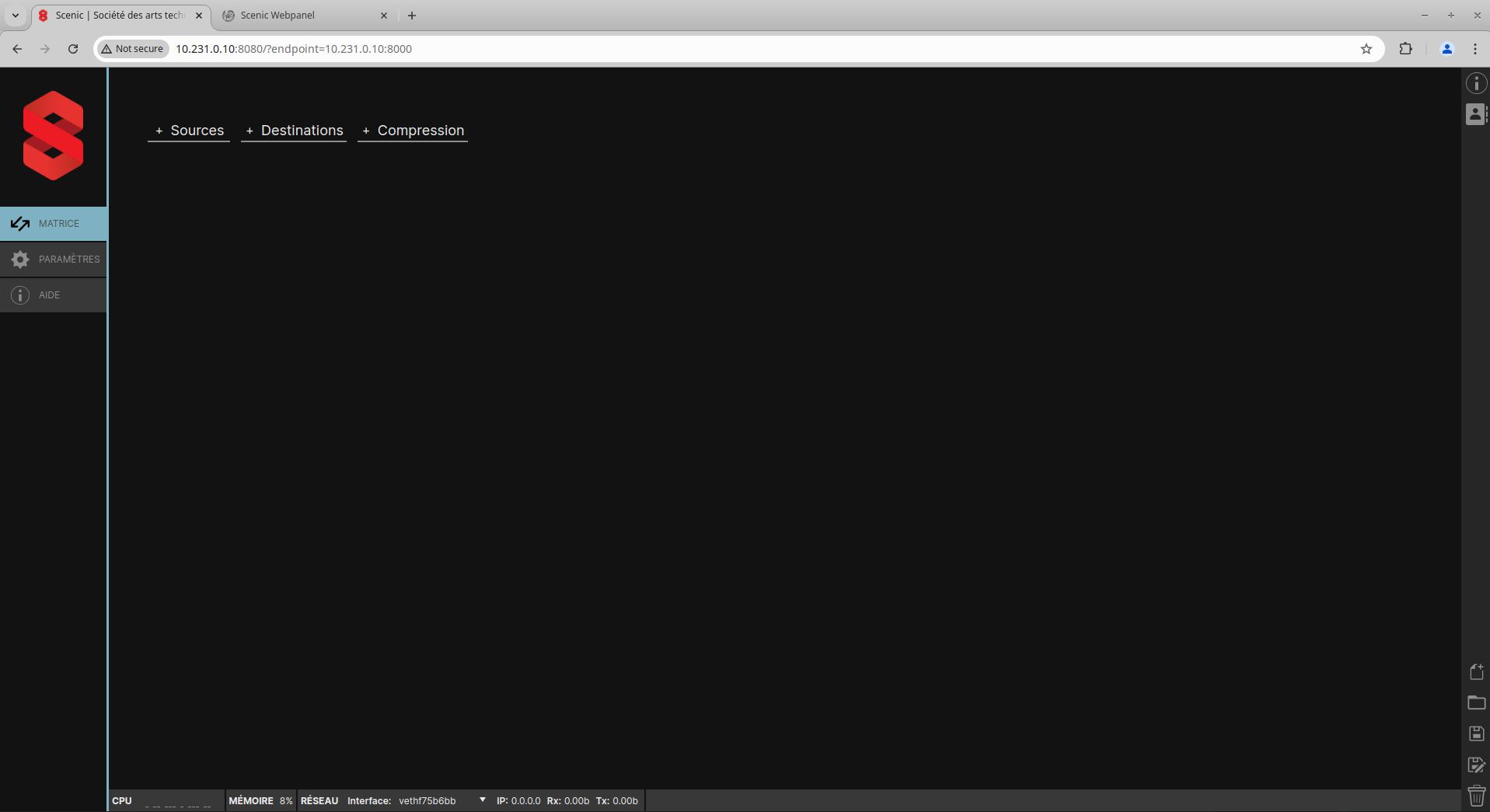 |
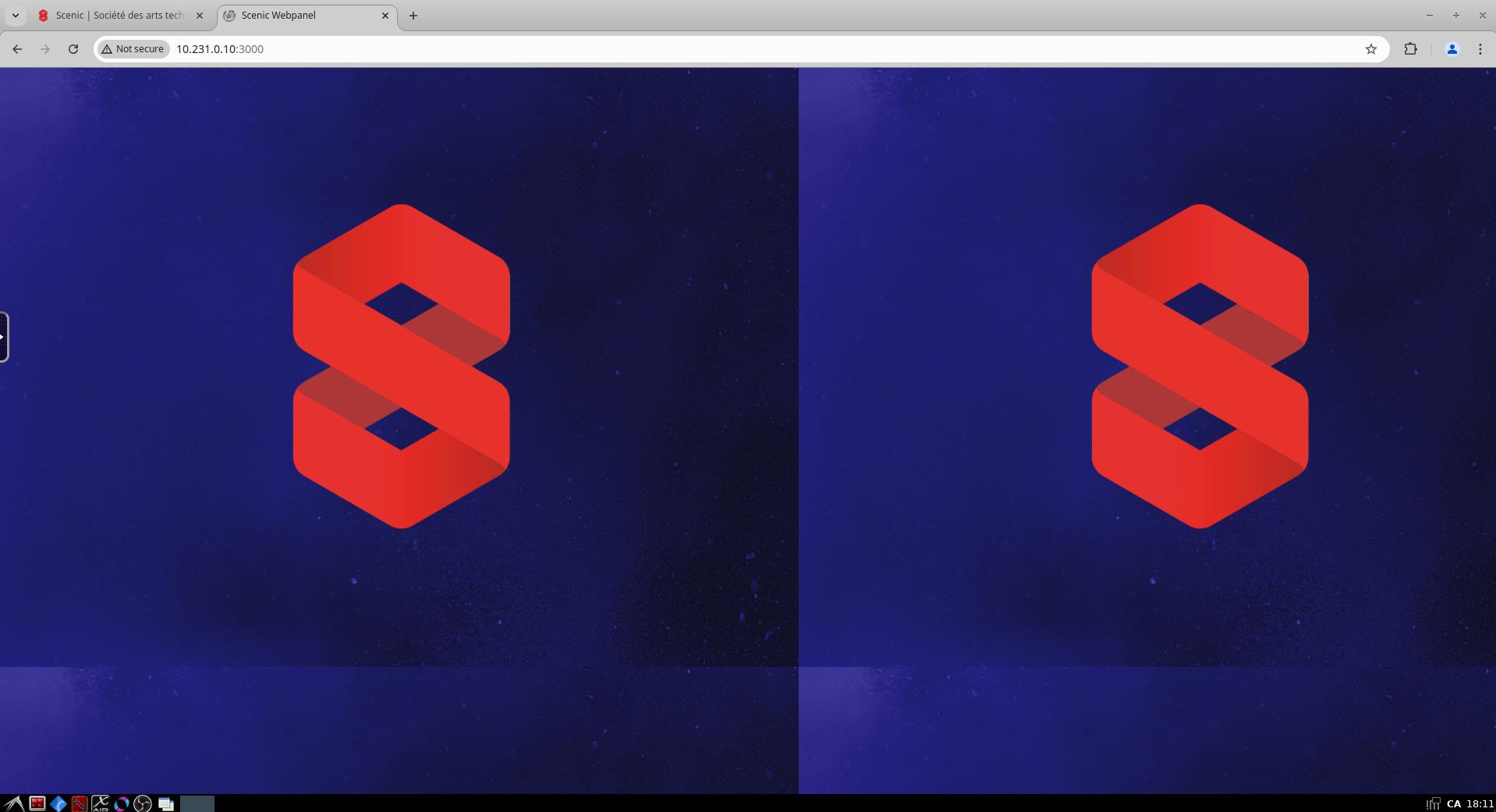 |
|---|---|---|
| Portal | Scenic Application | Desktop / Webpanel |
Connecting to the station
There are two different approaches to control the mobile station:
- The first, called headless, is recommended and involves connecting to the station’s network to control it from your own computer. This can be done via WiFi (WLAN) or wired Ethernet (LAN).
- The other is to add a keyboard, mouse, and monitor and use the station’s internal computer as a workstation.
¶ Warning
It is not recommended to use both the headless and direct-monitor approaches simultaneously, as this can cause synchronization issues. If multiple people need to intervene at the same time, the headless approach is preferred.
WLAN Headless (wireless)
Required hardware:
- Scenic Mobile Station
- Laptop or desktop computer with WLAN (WiFi) capability
Steps
-
Power the Scenic Mobile system using the Neutrik power cable and the power switch. Allow the computer and router to start and boot for one to two minutes.
-
The WLAN (WiFi) networks ScenicMobile-XXXX 5GHz and ScenicMobile-XXXX 2.4GHz should appear, where XXXX corresponds to a unique identifier for your station.
-
Using your personal computer (laptop or desktop), connect to the ScenicMobile-XXXX 5GHz network using the appropriate credentials. The router inside the station should assign your personal computer and other connected devices an IP address in the private subnet 10.231.0.0/24.
-
Once connected to the wireless network, open a web browser (ideally Google Chrome or Mozilla Firefox) and open the Scenic Portal to access the following tabs:
-
Scenic Web App :
This address provides access to the Scenic web application for controlling the Scenic matrix and connected partners. Anyone connected to the same subnet can access the web application simultaneously, which makes control and monitoring easier in many situations. -
Scenic WebPanel :
This address provides access to the desktop web panel environment, allowing you to use other software besides Scenic that may be useful for station control. Anyone connected to the same subnet can access the web panel simultaneously, which also helps with control and monitoring. -
Q-SYS :
Instance for basic control of the audio inputs on the Q-SYS interface.
-
-
It is recommended to bookmark the Portal link to simplify future connections.
LAN Headless (wired)
Required hardware:
- Scenic Mobile Station
- Laptop or desktop computer with Ethernet port
- Ethernet cable
Steps
-
Power the Scenic Mobile system using the Neutrik power cable and the power switch. Allow the computer and router to start and boot for one to two minutes.
-
Connect your personal computer (laptop or desktop) with an Ethernet cable to one of the LAN connectors 3, 4, 5, or 6. Your computer should receive an IP address in the 10.231.0.0/24 subnet.
-
Once connected to the network, open a web browser (ideally Google Chrome or Mozilla Firefox) and open the Scenic Portal to access the following tabs:
-
Scenic Web App :
This address provides access to the Scenic web application for controlling the Scenic matrix and connected partners. Anyone connected to the same subnet can access the web application simultaneously, making control and monitoring easier in many situations. -
Scenic WebPanel :
This address provides access to the desktop web panel environment, allowing you to use other software besides Scenic that may be useful for station control. Anyone connected to the same subnet can access the web panel simultaneously, which also helps with control and monitoring. -
Q-SYS :
Instance for basic control of the audio inputs on the Q-SYS interface.
-
-
It is recommended to bookmark the Portal link to simplify future connections.
Scenic Station as a control workstation with display
- Scenic Mobile Station
- Mouse / Keyboard
- Monitor (screen) and HDMI cable
Steps
- Before powering on the station, connect your monitor/screen to HDMI output 1. Connect a mouse and keyboard to the USB ports.
- Power on the Scenic Mobile station using the Neutrik power cable and the power switch, then allow the computer and router to boot for about one minute.
- Once boot is complete, the Scenic logo should appear on your monitor/screen. At that point, you have access to the system desktop and can launch the Scenic application from the taskbar menu.